
Many people are reading right now that AI "programs now". What that actually means in a web developer's day-to-day work usually remains unclear. I'll show you using a project you have right in front of you: this website. In 2026 it got a new design, new content and a new technical foundation – and the AI agent Claude Code worked on almost all of these changes.
What is Claude Code?
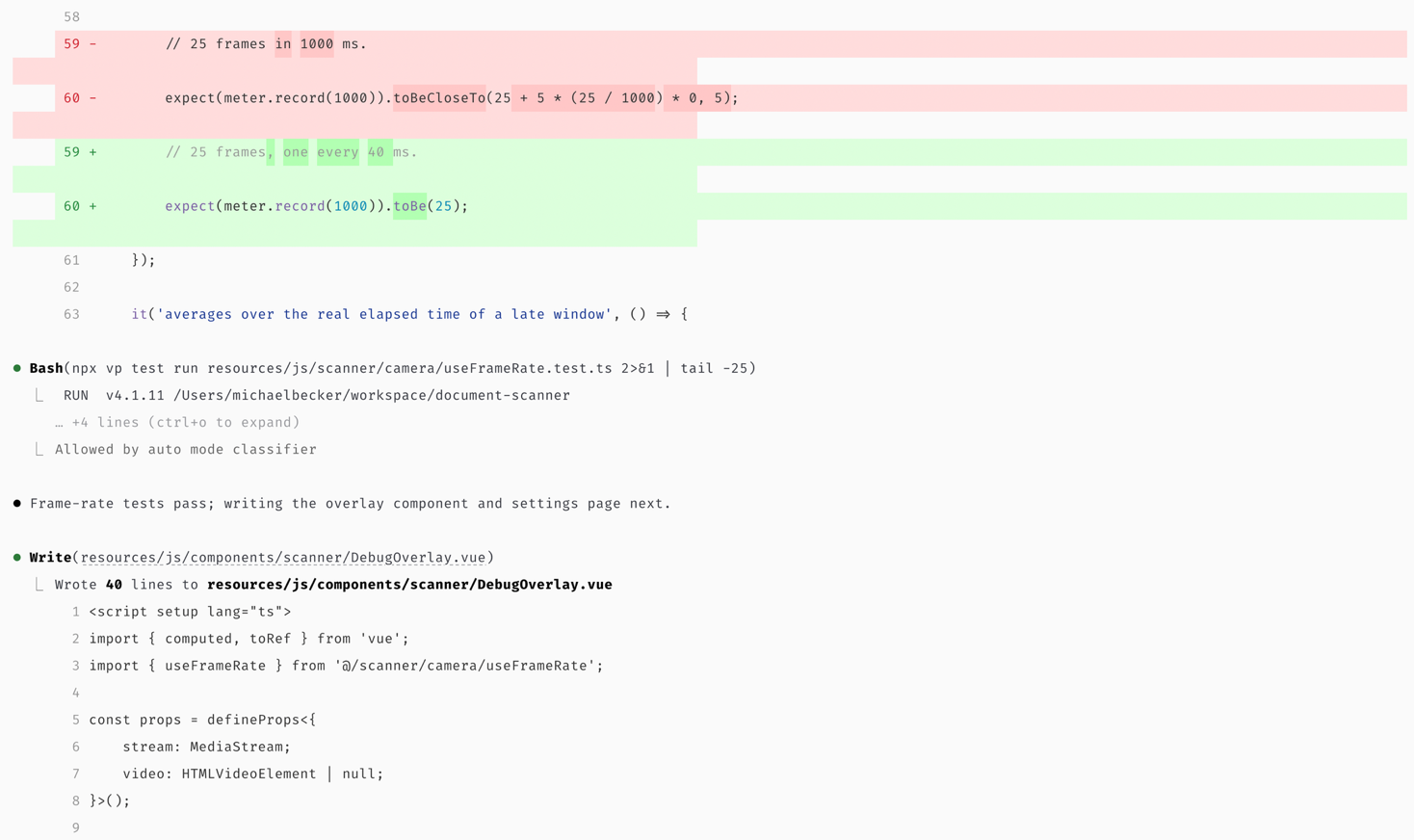
Claude Code is a coding agent by Anthropic. Unlike a chat window in the browser, it works directly inside a software project: it can read files, run commands in the terminal, change code and test whether the result works. You steer it in natural language.
That sounds like "the AI builds the website". But that's not how it is. A better description: I have a very fast, very well-read assistant that proposes and implements everything – and that I have to check constantly. I've summarised which other kinds of AI tools exist and when they are suitable in the article Building websites with AI in 2026.
What was done on this website
The changes can be traced in the project's version history. The most important steps were:
- Switch to the new Nera model: The website runs on Nera, my own static site generator. Instead of a copy of the entire generator, the project now only contains content, configuration and design, and includes Nera as a single package. Why I built Nera in the first place is explained in the article Why I built my own static site generator.
- New Nera features: a contact form without a server, an automatically generated sitemap and so-called asset hashing, so that browsers don't show outdated files from their cache after a change.
- Modernised stylesheets: The Sass files were moved from the deprecated
@importto the current module system. - New design "Technical Grid": The previous design is still in the project and can be reactivated with one line in the configuration.
- Eight new references, sorted by date and labelled as client project, own product or open source.
In the version history, each of these steps carries the note "Co-Authored-By: Claude". I think it's right to make that transparent.
And how much time did it save? The actual migration took about an hour with the agent. Without it, I would simply have set up the website from scratch and moved the content over – I would have estimated half a day to a full day for that. To be fair, that's not only down to the AI: Nera is very easy to set up, so part of the saving is also thanks to the tool.
What the collaboration looks like
The process is the same for almost every task:
- I set the goal. For example: "The references should show whether they are a client project, an own product or open source." This also includes decisions only I can make – such as which projects are shown at all.
- The agent reads up. It looks at the affected templates, content and configuration before changing anything.
- It proposes and implements. For larger tasks it discusses a plan first; for small ones it makes the change directly.
- I check every change. I read the changed code, build the site locally and look at the result in the browser – on desktop and on a smartphone.
- Small steps, saved one by one. Every completed change is saved as its own step in the version control system Git. If something goes wrong, it can be undone precisely.
Git is my safety net. Because every step is small and traceable, I never lose track of what has changed.
For developers: a few details
- Context is everything. A good README and a clear project structure help the agent just as much as a new team member.
- Run the checks. Build, linter and
nera validatecatch many errors before I even look at the browser. - Not too much at once. One task per step leads to better results than a long wish list.
- Read diffs, don't just look at results. A page can look right and still contain unnecessary or faulty code.
- Capture recurring tasks as skills. In Claude Code you can create your own skills: instructions in the project that the agent calls up by command. This project has, for example, one skill for blog posts and one for clean commits. That way I don't have to explain from scratch every time how I want something done.
- Work through tasks in a fixed process. Larger changes go through Snagio, my own task management tool. Every task goes through the same steps: plan, implement, review, approve – and only after my approval does it continue. Snagio isn't published yet; so far I only use it locally.
What worked well – and where I had to correct
From my point of view, these worked well:
- mechanical changes across many files, such as converting the stylesheets
- tidying up, for example removing images that were no longer used
- creating lots of similar content, such as the new references
- implementing the new design
About the design I have to admit something honestly, even if it's certainly not good news for designers: as a developer I now work a lot with Claude Design, a tool by Anthropic that creates designs and clickable prototypes from a description. I'm usually very happy with the results. The main factor, of course, is the cost saving.
I mainly have to correct when the agent overshoots: it includes things that weren't asked for at all. Once I only asked it to analyse a bug – I wanted to know exactly what caused it. The agent got going straight away and fixed the bug as well. In doing so it didn't follow my defined process, which prescribes certain steps so that I can follow changes concretely and step in if needed. That was annoying, and some of the changes had to be undone. That's why a clear, narrowly defined task is so important – and why I read every change before I accept it.
Conversely, the agent also found bugs, some of which had been in the old version for years: one reference was assigned incorrectly in the English version and therefore appeared twice on the German home page but not at all on the English one. The English error page had the title "Fehler 500". This was fixed in its own small step. Mistakes happen – with and without AI. What matters is that they get noticed.
By the way: this article too
Claude Code also prepared the drafts for this and other blog posts – based on the information on this website. Behind it is a dedicated skill that defines as precisely as possible what should be done how and what has to come out at the end. The agent suggests a topic, writes a draft with a clear structure and then asks me, point by point, about my experiences, which it then works into the text.
That suits me well: when it comes to finding topics, I'm not very creative. But once a topic and the structure of an article are in place, I'm very good at adding my own ideas and points and rewriting things. The experiences in this article – the time saved, the overshooting – therefore come from me, not from the AI.
Conclusion
An AI agent like Claude Code makes me much faster at many tasks. The responsibility still stays with me: I set the direction, make the decisions and check every single change before it goes online. For you as a client, that means more results for your budget, without compromising on care. I pass the time I save through the agent on to you one to one.
If you'd like to know how your website or web application can benefit from this way of working, get in touch.
Yours, Michael Becker